The Leadership Skills That Matter Most In Today’s Workplace
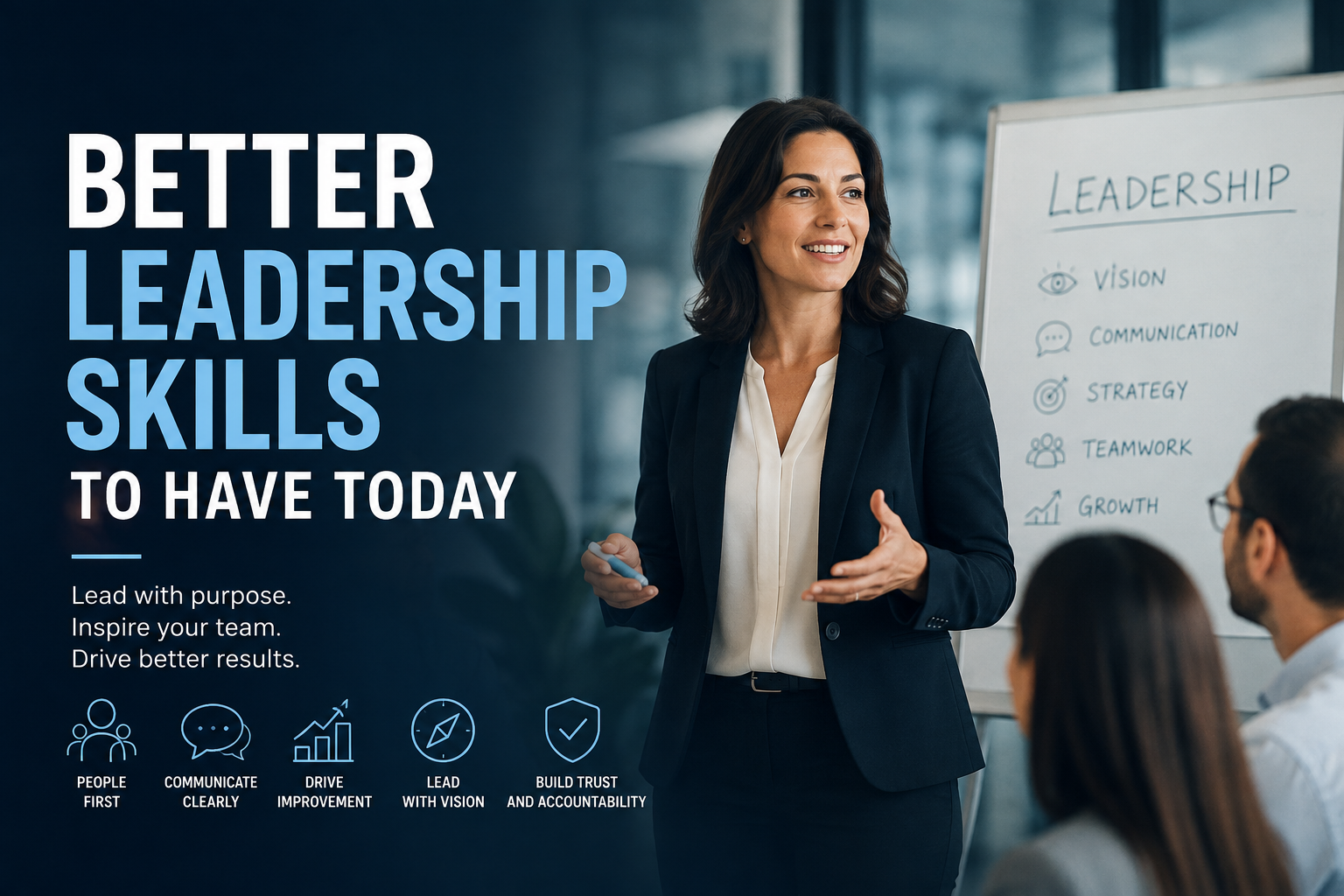
The Leadership Skills That Matter Most in Today’s Workplace
Leadership today is about more than holding a title or giving instructions. Modern organizations need leaders who can build trust, adapt to change, develop people, solve problems, and continuously improve the way work gets done.
Whether you lead a small team, manage operations, or are preparing for your first leadership role, developing the right skills can have a significant impact on both your career and your organization.
Here are eight leadership skills that are increasingly important in today’s workplace.
- Emotional Intelligence
Strong leaders understand that people do not all communicate, learn, or respond to challenges in the same way.
Emotional intelligence is the ability to recognize and manage your own emotions while also understanding the emotions and perspectives of others. Leaders with strong emotional intelligence listen carefully, remain professional under pressure, and approach difficult conversations with empathy.
A leader who understands people is better positioned to build trust, strengthen teamwork, and create an environment where employees feel respected.
- Clear and Effective Communication
Communication remains one of the foundations of leadership.
Employees need to understand what is expected of them, why the work matters, and how their performance contributes to the larger goal. Effective leaders communicate expectations clearly while also creating opportunities for employees to ask questions and provide feedback.
Good communication is not simply about speaking. Listening is equally important.
Before making assumptions, strong leaders seek to understand the situation, gather information, and listen to the people closest to the work.
- Adaptability and Change Leadership
Technology, automation, artificial intelligence, customer expectations, and economic conditions continue to change the workplace.
As a result, leaders cannot rely only on methods that worked in the past.
Adaptable leaders are willing to learn, experiment, and adjust their approach when circumstances change. More importantly, they help their teams understand and navigate change.
Instead of simply saying, “This is the new process,” effective leaders explain:
What is changing? Why is it changing? How will it improve our work? What support does the team need to succeed?
This turns change from an instruction into a shared journey.
- Data-Driven Decision-Making
Leadership requires judgment, but judgment becomes stronger when it is supported by reliable information.
Modern leaders should be comfortable working with metrics, KPIs, dashboards, trends, and operational data. They do not need to become data scientists, but they should understand how to use data to identify problems and make better decisions.
For example, when productivity decreases, a leader should avoid immediately assuming that employees are simply working slower.
The real issue could involve equipment downtime, training gaps, unnecessary movement, process complexity, staffing, inventory availability, or another operational constraint.
Good leaders ask questions before reaching conclusions.
- Continuous Improvement Thinking
One of the most valuable leadership questions is:
“How can we make this process better?”
Continuous improvement encourages leaders and employees to regularly identify waste, remove unnecessary steps, improve quality, and create safer and more efficient processes.
Methods such as Lean, Six Sigma, 5S, root-cause analysis, PDCA, and standard work can provide useful frameworks, but continuous improvement is ultimately a mindset.
Great leaders also involve employees in improvement efforts because the people performing a process every day often understand its challenges better than anyone else.
- Developing People, Not Just Managing Performance
A leader’s responsibility should extend beyond today’s productivity numbers.
Strong leaders develop the people around them.
That means coaching employees, recognizing strengths, identifying development opportunities, providing constructive feedback, and helping people prepare for future responsibilities.
Instead of asking only:
“Did we achieve today’s goal?”
Leaders should also ask:
“What did my team learn today, and how am I helping them become better tomorrow?”
When employees grow, organizations become stronger.
- Accountability and Ownership
Effective leadership requires accountability at every level—including from the leader.
Strong leaders establish clear expectations, follow through on commitments, and address problems consistently. When something goes wrong, they focus on understanding the root cause rather than immediately searching for someone to blame.
They also recognize their own responsibility.
A leader who can say, “I could have communicated that more clearly” or “We need to improve this process” demonstrates maturity and creates a culture where learning from mistakes is possible.
Accountability combined with respect creates stronger teams than fear-based leadership.
- Strategic Thinking
Great leaders learn to look beyond the immediate problem.
While daily execution is important, leaders should also consider how today’s decisions affect tomorrow’s performance.
Strategic thinking means understanding the connection between people, processes, technology, customers, quality, cost, safety, and organizational goals.
For example, increasing production quickly may appear successful, but if it also increases defects, employee fatigue, or rework, the organization may not actually be improving.
Effective leaders balance productivity, quality, people, cost, and long-term sustainability.
Leadership Is a Skill That Must Be Practiced
Leadership is not something people finish learning after receiving a promotion.
It develops through experience, reflection, feedback, education, mistakes, and continuous improvement.
The strongest leaders remain students of leadership. They continue asking questions, learning new technologies, developing their teams, analyzing performance, and challenging themselves to improve.
The workplace will continue to evolve, but one principle will remain important:
Organizations need leaders who can improve processes while bringing out the best in people.
Technology can automate tasks. Data can reveal opportunities. AI can accelerate decision-making.
But leadership still requires something deeply human: the ability to create trust, provide direction, develop others, and inspire people to work toward a common purpose.
Better Operations Hub
At Better Operations Hub, we explore practical approaches to leadership, continuous improvement, operational excellence, Lean thinking, data-driven decision-making, and professional development.
Better processes create better results. Better leadership creates stronger teams.