Lessons from Boeing’s Quality Control Failures
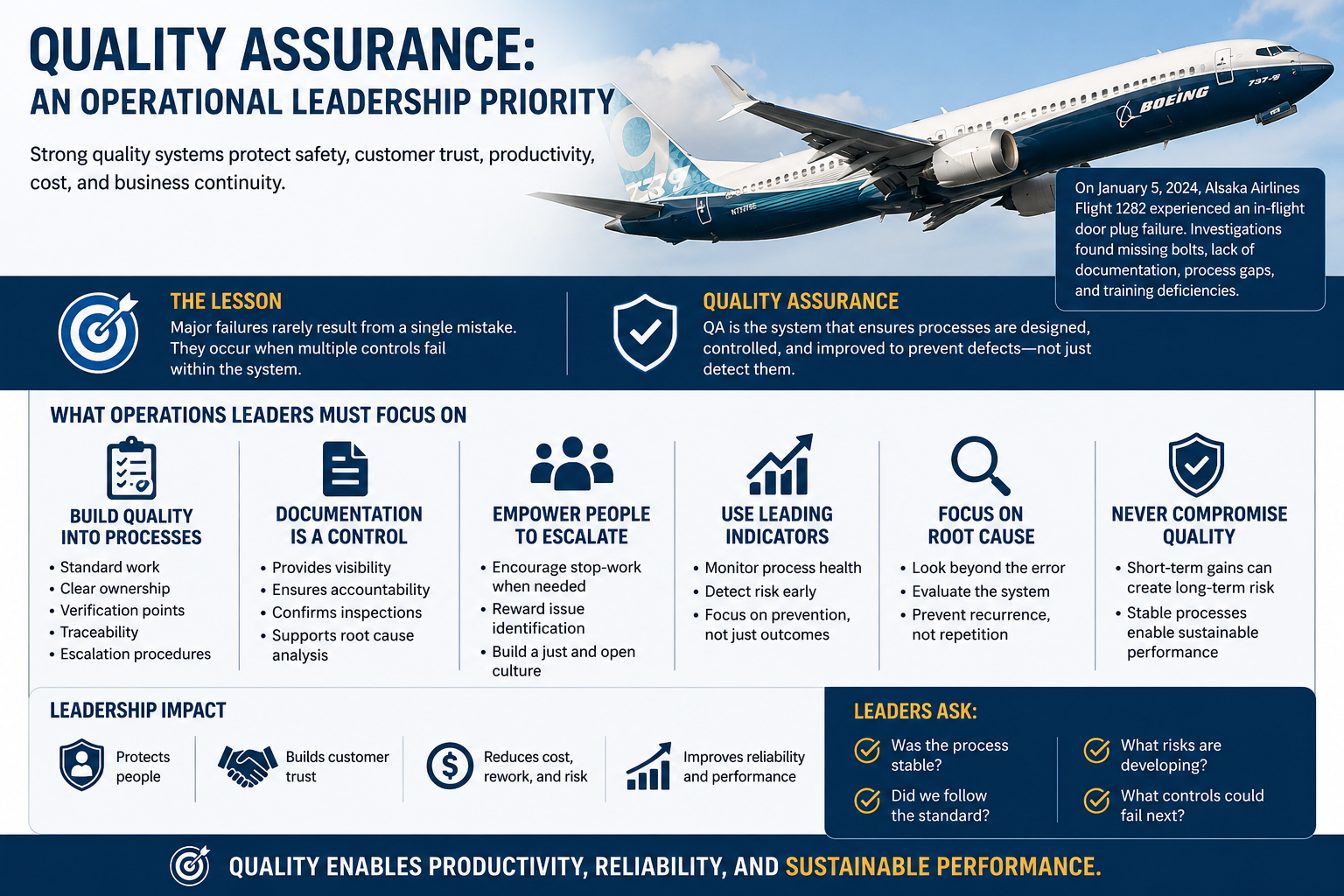
Lessons from Boeing’s Quality Control Failures
Why Quality Assurance Matters for Operations Managers and Senior Leaders
Quality Assurance is more than an inspection function. In high-performing organizations, it is a core operational discipline that protects safety, customer trust, productivity, cost, compliance, and long-term business performance.
For Operations Managers and Senior Managers, the goal is not simply to detect defects after they occur. The goal is to build processes that prevent defects from happening in the first place.
The Boeing 737-9 MAX door-plug failure provides a strong example of why Quality Assurance must be embedded into operations, leadership, training, documentation, and process control.
Boeing Quality Control Failure: An Operations Case Study
In January 2024, an Alaska Airlines Boeing 737-9 MAX experienced an in-flight door-plug separation shortly after takeoff.
The investigation later identified missing securing bolts, along with broader concerns involving documentation, process compliance, training, and quality verification.
From an operations perspective, the most important lesson is that major failures are rarely caused by a single mistake.
They usually happen when multiple controls fail at the same time.
A missing step may lead to incomplete documentation.
Incomplete documentation may prevent an inspection.
A missed inspection may allow a defect to move downstream.
That defect can eventually reach the customer.
For Operations Leaders, this is why Quality Assurance should be viewed as a complete operating system rather than a separate department.
What Is Quality Assurance in Operations?
Quality Assurance is the structured approach an organization uses to ensure processes consistently meet established standards.
Quality Control focuses primarily on identifying defects.
Quality Assurance focuses on preventing them.
A strong Quality Assurance system includes:
- Standardized work
- Process controls
- Training and competency
- Documentation and traceability
- Audits and verification
- Supplier quality management
- Corrective actions
- Root-cause analysis
- Performance monitoring
- Continuous improvement
The objective is simple: reduce variation, prevent quality escapes, and build reliable processes.
Build Quality Into the Process
One of the most important responsibilities of an Operations Manager is ensuring that quality is built directly into the workflow.
Critical processes should not depend primarily on memory, verbal communication, or individual judgment.
Instead, leaders should establish:
- Clear standard operating procedures
- Defined ownership
- Verification checkpoints
- Error-proofing controls
- Escalation procedures
- Process traceability
The stronger the process design, the less the organization depends on catching mistakes later.
This is a fundamental principle of Lean operations and continuous improvement.
Documentation Is an Operational Control
Documentation is often treated as administrative work, but in Quality Assurance it serves a much larger purpose.
Accurate documentation provides evidence that the process was followed correctly.
It helps leaders understand:
- Who performed the work
- What was changed
- When the work occurred
- Whether required inspections were completed
- Whether deviations were approved
- Whether corrective actions were implemented
Without traceability, Operations Leaders lose visibility and accountability.
The Boeing case demonstrates how missing documentation can contribute to a larger quality failure when required verification steps are not triggered.
Production Targets Should Never Override Quality
Senior Operations Leaders constantly balance productivity, cost, service, safety, and quality.
However, production performance becomes dangerous when output targets begin to encourage teams to bypass critical controls.
Higher throughput does not represent operational excellence if it produces:
- More defects
- More rework
- More downtime
- More customer complaints
- Higher safety risk
- More corrective actions
Sustainable productivity depends on process stability.
Strong leaders focus on improving the process before pushing the process harder.
Create a Strong Quality Culture
A successful Quality Assurance system also depends on culture.
Employees closest to the work often identify problems before those problems appear in reports or dashboards.
Leaders should create an environment where employees feel responsible for raising concerns.
Employees should be able to say:
“This process is outside the standard.”
“This work requires additional verification.”
“This issue needs to be escalated.”
“We should stop before continuing.”
Quality improves when identifying a problem is viewed as responsible leadership behavior rather than a disruption to production.
Use Leading Quality Indicators
Many organizations focus on lagging indicators such as defects, returns, complaints, and rework.
These measures are important, but they identify problems after they have already occurred.
Operations Managers should also monitor leading indicators that show whether process health is beginning to deteriorate.
Important Quality Assurance metrics include:
- Process deviations
- Audit compliance
- First-pass yield
- Repeat defects
- Training competency
- Corrective-action closure rates
- Supplier defect trends
- Near misses
- Documentation compliance
- Quality escapes
Leading indicators give leadership an opportunity to act before a small issue becomes a major failure.
Root-Cause Analysis Should Focus on the System
When a quality failure occurs, management should avoid stopping the investigation at the individual error.
The more important question is:
Why did the system allow the error to reach the next stage?
Effective root-cause analysis should evaluate:
- Process design
- Training
- Leadership oversight
- Documentation
- Equipment
- Supplier performance
- Workload
- Communication
- Quality controls
Tools such as 5 Whys, Fishbone Diagrams, DMAIC, FMEA, and Corrective and Preventive Action can help organizations move beyond symptoms and identify systemic causes.
Accountability remains important, but replacing an employee without improving the process leaves the same risk in place.
Key Quality Assurance Priorities for Operations Managers
Operations Managers and Senior Managers should focus on several priorities:
- Standardize critical processes.
- Build verification into high-risk activities.
- Improve documentation and traceability.
- Monitor leading quality indicators.
- Strengthen training and process competency.
- Encourage early escalation of quality concerns.
- Use root-cause analysis to prevent recurrence.
- Hold suppliers accountable to consistent standards.
- Verify corrective actions for effectiveness.
- Protect quality even when production pressure increases.
Quality Assurance Supports Operational Excellence
The strongest operations organizations do not treat quality as separate from performance.
Quality supports performance.
A stable process produces fewer defects.
Fewer defects reduce rework.
Less rework improves productivity.
Higher consistency improves customer trust.
Better process control reduces operational risk.
That is why Quality Assurance should be viewed as a business performance system.
Final Takeaway
The Boeing quality control failures demonstrate that small process breakdowns can become major operational, financial, reputational, and safety risks.
For Operations Managers and Senior Leaders, the lesson is clear:
Quality must be designed into the process, reinforced by leadership, measured with the right indicators, and protected even under production pressure.
Operational excellence is not achieved by choosing between productivity and quality.
It is achieved by building reliable systems where quality enables productivity, safety, customer trust, and sustainable performance.